You don’t need expensive gear to make coffee that tastes clean, sweet, and satisfying at home. Most “bad coffee days” come from a few small issues, like stale beans, off-tasting water, the wrong grind size, or a ratio that’s all guesswork.
In this guide, you’ll get practical coffee tips you can use tomorrow morning. You’ll learn how to pick the best coffee beans for your taste, keep coffee fresh, choose better water for coffee, set a simple coffee to water ratio, match grind size to your brew method, and fix the most common flavor problems fast.
Small changes can shift your cup from “fine” to “wow,” and you’ll feel that difference right away.
Start with better ingredients: beans, freshness, and water
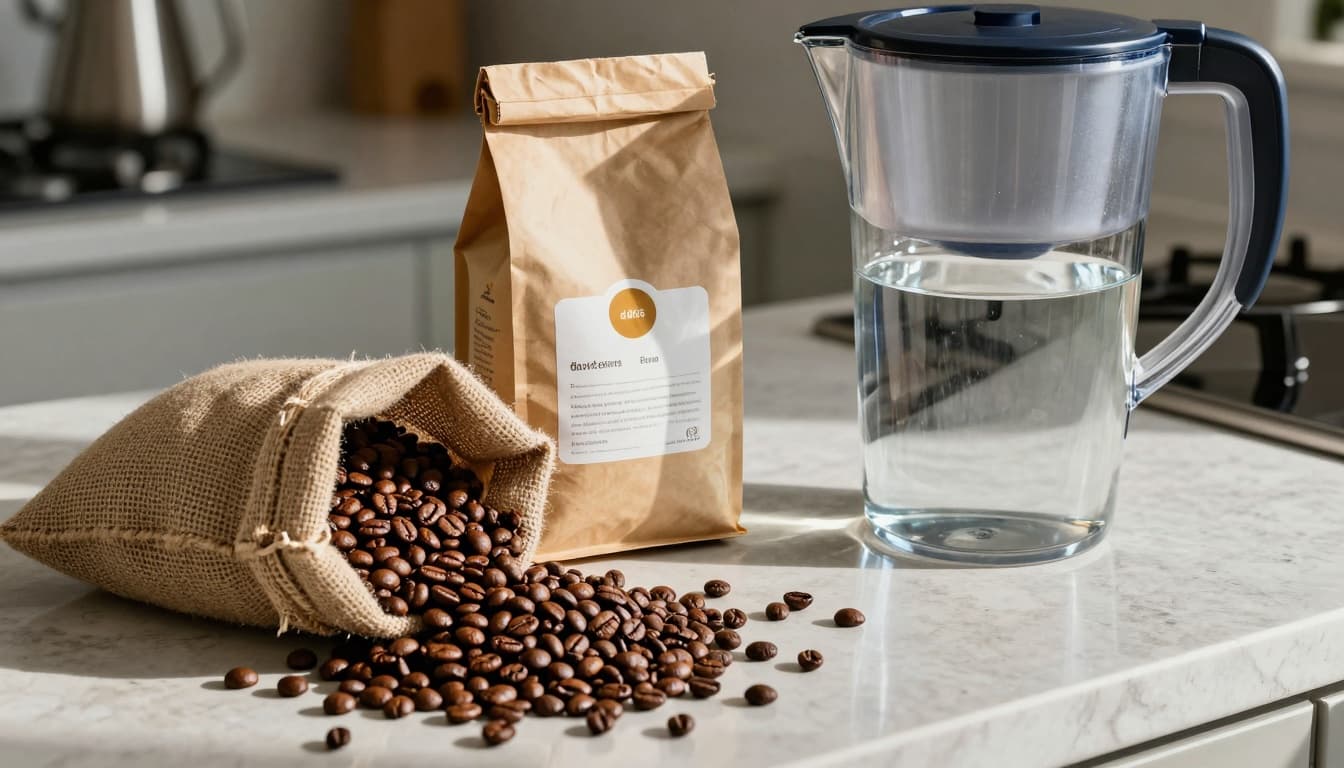
Caption: Fresh beans, a roast-date bag, and filtered water on a home counter (image generated by AI).
If you want the biggest quality jump, start here. Brewing skill matters, but ingredients matter more. Great technique can’t rescue old beans or water that tastes like a swimming pool.
How to pick coffee beans you will actually like
Coffee shopping gets easier once you tie roasts to flavors you recognize.
- Light roast: Brighter, more “sparkly” flavors. You might taste fruit, citrus, or floral notes. It can feel lighter on the tongue, and it’s often less bitter (but it can taste sour if under-brewed).
- Medium roast: Balanced and friendly. You’ll often get caramel, chocolate, nuts, and a rounder sweetness. If you’re unsure, start here.
- Dark roast: Bold, smoky, and heavier-bodied. It tends to taste more bitter, and it can hide subtle flavors. If you like “classic diner coffee,” this is usually the profile.
A simple way to choose:
- If you like chocolate and nuts, try a medium roast from Brazil or a “chocolatey” blend.
- If you like fruit and bright flavors, try a light roast (often African coffees lean this way).
- If you want bold and smoky, go darker, but buy small amounts so it stays fresh.
When possible, buy whole bean. Pre-ground coffee loses aroma quickly because more surface area touches air. Whole bean usually tastes better for a simple reason: you keep more of the flavors trapped inside until brew time.
If you must buy pre-ground, pick the freshest bag you can and store it well. You can still make a good cup, just aim to use it faster.
Freshness and water quality tips that change the flavor fast
Roast date beats “best by.” A “best by” date can be far away even when coffee has already faded. If you see a roast date, use that as your guide.
A practical freshness window:
- Coffee often tastes best after a short rest (many coffees improve a few days after roasting).
- Then it stays in a good zone for a few weeks.
- After that, it can start tasting flat, papery, or dull.
You don’t need to get obsessive. Just buy smaller bags more often, and try to finish them while they still smell lively.
Storage rules that work:
- Keep coffee in an airtight container.
- Store it cool and dark, like a pantry cabinet.
- Avoid the fridge, since moisture and food odors can creep in.
- If you bought a large bag, you can freeze part of it in a well-sealed container, and only open it when it’s back at room temp (so you don’t get condensation on the beans).
Now, water. Coffee is mostly water, so water for coffee can make or break flavor.
Quick water tips:
- Use cold, clean water.
- If your tap water tastes like chlorine or metal, use filtered water.
- Avoid distilled water most of the time. It can make coffee taste flat because it has no minerals to help pull flavor into the cup.
If your coffee tastes “off” even with good beans, try changing only the water for a week. It’s often the hidden problem.
Dial in grind size, ratio, and temperature for consistent coffee
Once your ingredients are solid, consistency is your next win. You’re aiming for repeatable results, not mystery coffee that changes day to day.
The three dials you’ll use most are:
- Coffee to water ratio
- Grind size
- Ideal coffee temperature
A simple coffee ratio you can remember (and how to adjust it)
Here’s a baseline that works for many brew methods:
Start at 1:16 by weight (1 gram coffee to 16 grams water).
That means:
- 20 g coffee, 320 g water
- 30 g coffee, 480 g water
If you don’t have a scale, you can still make coffee, but a cheap kitchen scale is the easiest upgrade for better consistency. You stop guessing, and your “good cup” becomes repeatable.
How to adjust without getting lost:
- Want it stronger? Use a bit more coffee (try 1:15).
- Want it lighter? Use a bit more water (try 1:17).
Two quick examples you can use:
- One mug: Try 20 g coffee to 320 g water (about a medium-large cup).
- Small batch: Try 30 g coffee to 480 g water (enough for two smaller cups).
You don’t need perfect math. You need a starting point and small changes. When you change one thing at a time, your taste becomes your guide.
Grind size and water temperature, quick guidelines by brew method
Grind size controls how fast water pulls flavor from coffee.
- Too fine often tastes bitter, dry, or harsh (over-extracted).
- Too coarse often tastes sour, weak, or watery (under-extracted).
Use this as a simple grind size chart:
| Brew method | Grind size | What it should look like |
|---|---|---|
| French press | Coarse | Like chunky sea salt |
| Drip coffee maker | Medium | Like regular sand |
| Pour over | Medium-fine | Like finer sand |
| Espresso | Fine | Like powdered sugar (not flour) |
Temperature matters too. For most methods, aim for water that’s near boiling but not aggressively boiling. If you have a kettle with temperature control, you can keep it simple:
- Medium and light roasts usually taste best with hotter water.
- Dark roasts can taste more bitter with very hot water, so slightly cooler water can help.
Taste cues you can trust:
- If your coffee tastes sour, your water might be too cool (or your grind too coarse, or your brew too short).
- If your coffee tastes bitter, your water might be too hot (or your grind too fine, or your brew too long).
Brew it right: easy tips for drip, pour over, French press, and cold brew
You don’t need a perfect routine. You need a few habits that make any method more forgiving. If you build these into your brew, you’ll get a smoother cup with less effort.
Small technique upgrades that make any brew taste smoother
These are small moves that pay off fast:
Rinse paper filters. Run hot water through the filter before brewing. This helps remove papery taste and warms the brewer.
Warm your mug. A cold mug steals heat, and heat affects flavor and aroma. A quick rinse with hot water helps.
Bloom fresh coffee. If you’re doing pour over or a manual drip method, wet the grounds with a small amount of water first, then wait a short moment before adding the rest. This helps fresh coffee release gas so extraction is more even.
Pour slowly and evenly. A steady pour helps all grounds extract at a similar rate. If you dump water in one spot, you can get channels, and that makes coffee taste both weak and sharp.
Stir or swirl once. A gentle stir or swirl early on can help with even saturation.
Use a timer. You don’t need to chase perfect seconds, but timing helps you repeat what worked.
Brew method quick fixes (when you are short on time)
When your morning is packed, you can still avoid the common mistakes.
Drip coffee maker
- Don’t overfill the basket, since it can clog and overflow.
- After adding grounds, level the bed with a small shake, so water flows more evenly.
- If your machine has a “keep warm” plate, don’t let coffee sit too long. Heat can make it taste burnt.
Pour over
- Keep the water level steady, don’t flood it and then let it drain completely.
- Pour in circles, then finish with a small center pour to settle the bed.
- If it drains too fast and tastes weak, go a bit finer.
French press
- Use a coarse grind and don’t crush the plunge. Press slowly.
- If it tastes muddy, let it sit a moment after plunging, then pour gently.
- If you see thick foam, skimming a bit can reduce bitterness for some beans.
Cold brew
- Go coarser and steep longer for a smooth concentrate.
- Strain well, since fine sediment makes it taste gritty.
- Dilute to taste. Many people prefer it with extra water or milk.
Troubleshooting coffee problems: bitter, sour, weak, or watery
This is your quick diagnosis section. When coffee tastes wrong, it’s usually one of a few causes. Fix the big issue first, then adjust in small steps.
If your coffee tastes bitter or dry
If you’re thinking, “My coffee tastes bitter,” the most common reason is over-extraction.
Common causes:
- Grind is too fine
- Brew time is too long
- Water is too hot
- You used too much coffee for the water
- Beans are old or roasted very dark
- Your brewer is dirty, old oils turn rancid
Fast fixes you can try tomorrow:
- Go one step coarser on the grinder.
- Shorten contact time (steep less in French press, or speed up pour over slightly).
- Use slightly cooler water, especially with dark roasts.
- Loosen the ratio a bit (move from 1:15 toward 1:16 or 1:17).
- Buy fresher beans, and avoid giant bags unless you drink a lot.
- Clean your gear with hot water and a mild cleaner. Pay attention to lids, carafes, and mesh filters where oils hide.
One helpful mindset: bitterness isn’t always “strong coffee.” It’s often coffee that’s been pushed too far.
If your coffee tastes sour, weak, or watery
If you’re thinking, “My coffee tastes sour,” you’re usually tasting under-extraction. If you’re thinking, “How to fix weak coffee,” the answer is often the same set of adjustments.
Common causes:
- Grind is too coarse
- Brew time is too short
- Water is too cool
- Not enough coffee in your coffee to water ratio
- Uneven pouring, not all grounds got wet
Fast fixes:
- Go one step finer.
- Brew a bit longer (or slow your pour).
- Use hotter water, close to boiling for many methods.
- Tighten the ratio (move from 1:17 toward 1:16 or 1:15).
- Make sure all grounds get wet, especially around the edges of a pour over.
If your cup is both sour and weak, don’t chase it with extra coffee first. Start by making extraction more even (finer grind, hotter water, longer time). Then adjust strength.
Conclusion: a simple checklist for better coffee tomorrow
If you want better coffee fast, keep it simple: buy fresh coffee, use better-tasting water, start with a 1:16 coffee to water ratio on a scale, match grind size to your brew method, and write down what you changed. When something tastes off, troubleshoot by taste, bitter usually means back off, sour usually means push extraction a bit more.
Change one thing at a time, and you’ll learn your preferences quickly. Save the ratio tip, pick one brew method to practice this week, and see how much better your daily cup can get.
Leave a Reply